You arrive at a lush wellness retreat in Sri Lanka. A man in a white sarong greets you. He is introduced as “The Doctor.” He checks your pulse, prescribes an oil, and schedules a treatment.
But in a country where hospitality is king, the title “Doctor” is sometimes used loosely as a mark of respect rather than a medical credential.
If you are seeking Ayurveda for serious healing—detox, stress management, or treating chronic ailments—you need to know: Is the person treating me a qualified medical professional?
Here is your guide to decoding the qualifications and verifying your Ayurvedic physician in Sri Lanka.
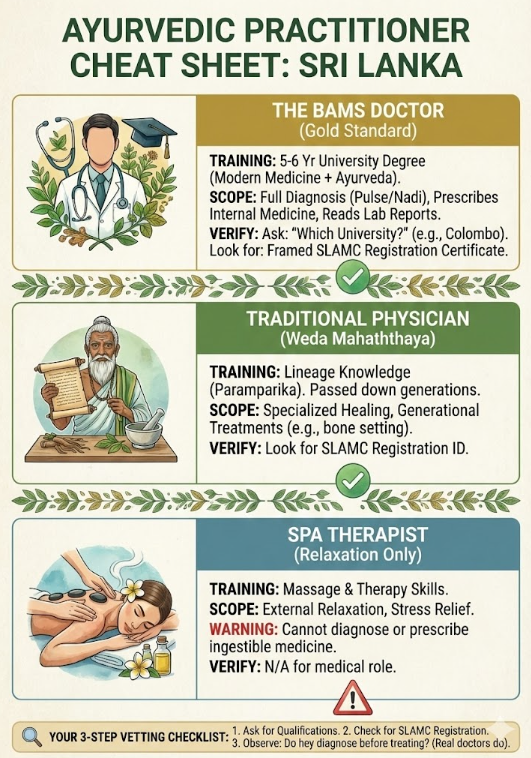
🎓 The Gold Standard: What is a BAMS Degree?
Just as Western medicine has the MBBS, Ayurvedic medicine has the BAMS.
BAMS stands for Bachelor of Ayurvedic Medicine and Surgery. It is not a weekend course. It is a rigorous 5 to 6-year university degree followed by a compulsory internship.
What a BAMS Doctor Knows:
A BAMS graduate has studied a dual curriculum. They don’t just know herbs; they know human biology.
- Modern Medicine: Anatomy, Physiology, Pathology, and Diagnostic methods (reading blood tests, X-rays, MRI).
- Ayurvedic Medicine: Nadi Vijnana (Pulse diagnosis), Herbology, and ancient treatment protocols.
The Major Universities: If your doctor holds a BAMS, they likely graduated from one of these prestigious state institutions:
- Institute of Indigenous Medicine (University of Colombo)
- Gampaha Wickramarachchi University of Indigenous Medicine (Formerly affiliated with Kelaniya)
- University of Jaffna (Unit of Siddha Medicine)
- Eastern University
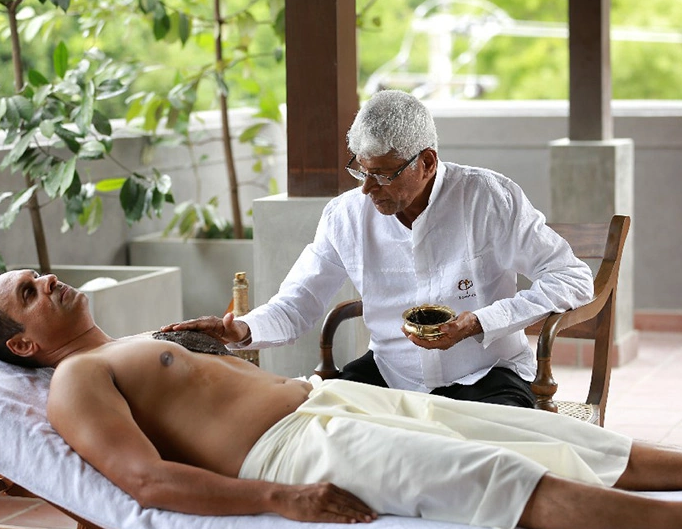
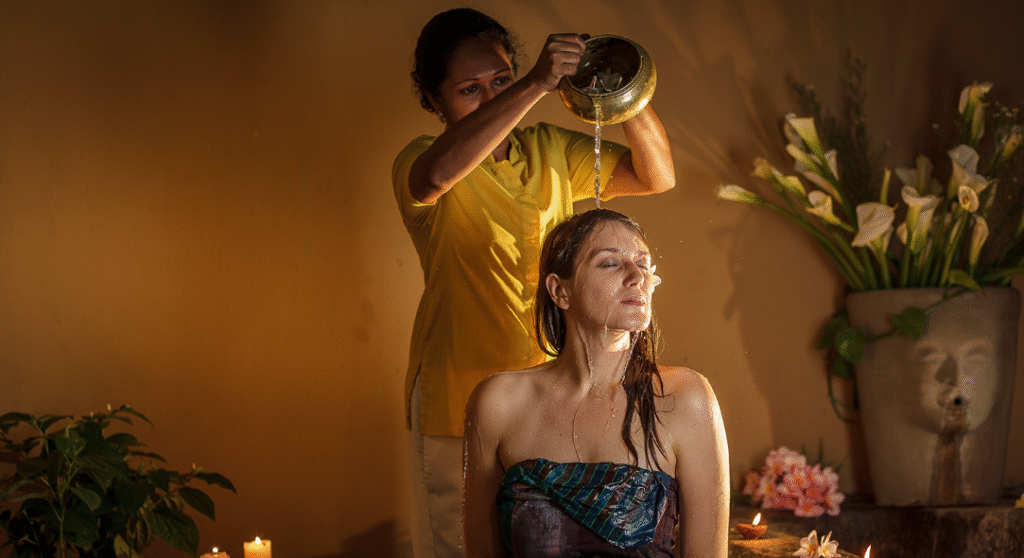
Pro Tip: A BAMS doctor can read your Western medical reports (like cholesterol levels or thyroid profiles) and interpret them through an Ayurvedic lens. This is the bridge you need as a foreign traveler.
🕰️ The “Paramparika” Factor (The Traditional Lineage)
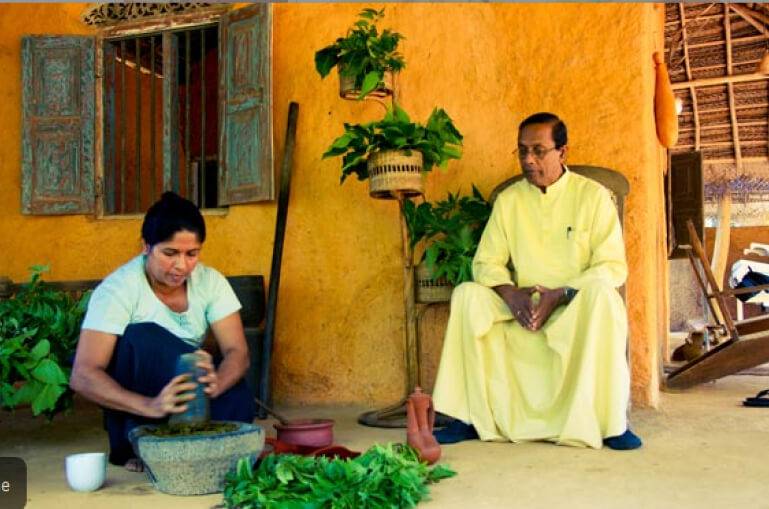
Sri Lanka also has a second, deeply respected category of healers: the Traditional Physicians (often called Weda Mahaththaya).
These healers may not hold a BAMS degree. Instead, they hold knowledge passed down through generations of their family lineage. They are often specialists in specific fields (e.g., bone setting, snake bites, or burns).
Are they legitimate? Yes, many are registered with the Ayurvedic Medical Council. However, for a general wellness tourist, verifying their credentials can be harder, and the language barrier (medical English) can sometimes be an issue compared to university-educated BAMS doctors.
🔍 The Verification Checklist: How to Ask
You have every right to know who is treating you. A genuine physician will never be offended by your curiosity. Here is how to verify:
1. The “University” Question
Politely ask: “Which university did you graduate from?”
- Valid Answer: “I studied at Colombo University / Gampaha Wickramarachchi.”
- Red Flag: “I studied at a private academy” or “I learned from a guru in a temple.” (This might mean they are a therapist, not a doctor).
2. Look for the Registration
Every qualified Ayurvedic practitioner (BAMS or Traditional) must be registered with the Sri Lanka Ayurvedic Medical Council (SLAMC).
- Ask to see their SLAMC Registration ID.
- In their office, look for a framed certificate with a registration number.
3. The Scope of Practice
- Real Doctor: Will take your pulse, ask about your medical history, sleep patterns, and digestion before prescribing anything. They wear a stethoscope (often) and act like a clinician.
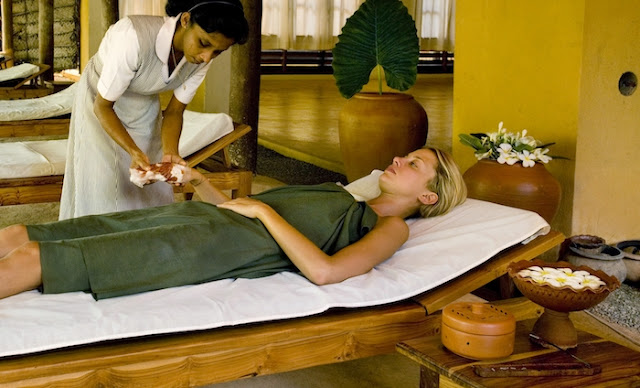
- Spa Therapist: Will ask “Soft or hard pressure?” and immediately start massaging. This is not a doctor.
⚠️ The “Spa Doctor” Trap
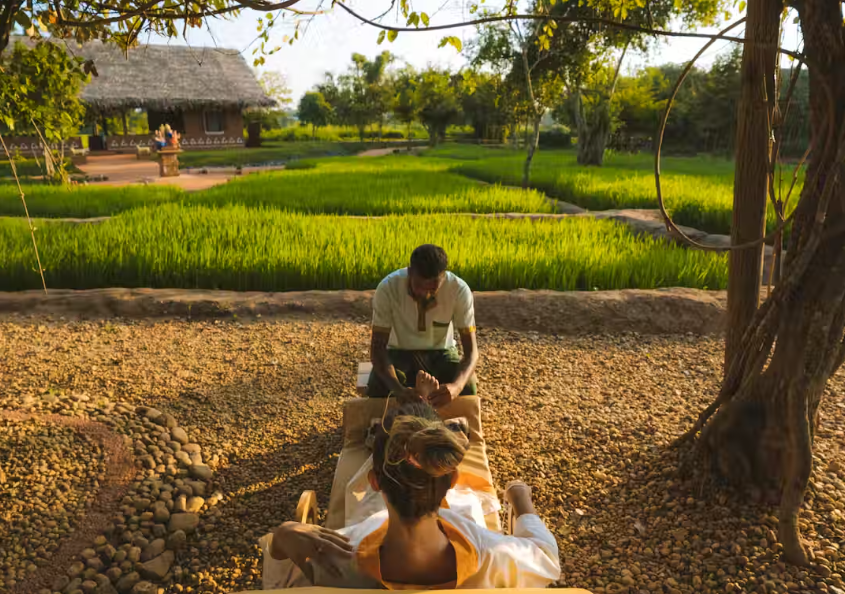
In some tourist-heavy areas, a senior therapist might be called “Doctor” simply because they are experienced in massage.
- The Danger: They may be excellent at massage, but they are not qualified to diagnose internal diseases or prescribe herbal medicines that you ingest.
- The Rule: Never ingest herbal medicine unless it is prescribed by a SLAMC-registered physician.
🇱🇰 The Bottom Line
Sri Lanka is home to some of the world’s most brilliant Ayurvedic minds. To experience the true power of this medical system, ensure you are in the hands of a professional.
- For Relaxation: A skilled therapist is fine.
- For Healing: Look for a BAMS degree holder or a well-experienced, SLAMC-registered Traditional Doctor.
Trust your intuition, ask the right questions, and respect the science behind the spirituality.
Too many acronyms to remember? Don’t worry about memorizing the difference between a BAMS and SLAMC right now. We have created a quick-reference Cheat Sheet that summarizes everything you need to check. 📲 [Download/View the Cheat Sheet Here] Save this to your phone and glance at it before your first consultation to ensure you are in safe hands.